- The Sleuth
- Posts
- Goldman Sachs CEO Bullish On Bitcoin, Stripe And Adyen vs. Modern Treasury & More
Goldman Sachs CEO Bullish On Bitcoin, Stripe And Adyen vs. Modern Treasury & More
Also: OpenAI launches new crypto tool.

Welcome back!
This is J264G and this week I’ve got these titbits for you:
Bitcoin Allocation: David Solomon discloses Bitcoin holdings.
Crypto Rails: Modern Treasury launches payment service provider.
Penetration Testing: OpenAI introduces EVMbench for crypto audits.
Erebor has everyone talking and it’s easy to see why: money that moves at internet speed beats money that keeps banker hours. It’s that simple.

Now, let’s jump right into this week’s newsletter!
Click on any underlined heading/hyperlink to learn more.
Spotlight
Frictionless Finance
We’ve poured billions into blockchains, shaved milliseconds off block times, and congratulated ourselves on decentralisation.
And yet, mass adoption still isn’t here.
Why?
Because the average user still has to moonlight as a cybersecurity analyst, memorise hardware wallet rituals, juggle browser extensions and apps, and sign a stack of transactions worthy of a home loan just to move five bucks. Meanwhile, your daily banking app masks staggering complexity behind a button that says “Send.” If crypto wants to win, it needs to stop flexing its plumbing and start obsessing over the interface.
The solution may lie in an agentic approach—one that lets humans set intent in plain English and leaves AI agents to handle the execution.
Consider this deceptively mundane command: “Send $5 to Dan.” In this scenario, my AI agent would reach out to Dan’s AI agent to negotiate the details. What follows is a flurry of activity under the hood, but I remain blissfully unaware of the technical ballet being performed on my behalf. Behind the scenes, my $5 might currently be sitting in a decentralised finance protocol on Solana earning yield. Dan, on the other hand, prefers to receive USDC on Ethereum. To bridge that gap, the agents autonomously map out an optimal solution: perhaps withdrawing my funds from the decentralised platform, swapping them into USDC, and bridging them over to Ethereum. In doing so, they consider a multitude of factors that a human user would find tedious and complex: which cross-chain route minimises cost and time, what trade-offs in privacy might be acceptable, and which intermediaries or protocols are trustworthy enough to facilitate the transfer. Each of these decisions is made in line with parameters that Dan and I have pre-defined in our agents’ configuration files—effectively our personal rulebooks for what our agents can and cannot do.
In short, we set the intent, and the agents handle the rest.
Financial history is clear on one point: the winners are those who bury complexity and elevate outcomes. Consumers do not crave process; they crave progress—frictionless, intuitive, immediate.
Platforms such as OpenClaw hint at what comes next: a financial layer where intent becomes the interface and execution recedes into the background. If that model scales, the promise of onchain finance will finally feel less like infrastructure and more like inevitability.
Chart Of The Week

News Bites
Penetration Testing: OpenAI has introduced EVMbench, a benchmark measuring how effectively AI agents can detect, fix, and exploit critical smart contract vulnerabilities. Coming after research from both Google DeepMind and Anthropic, the initiative signals intensifying interest among leading AI labs in the mechanics of crypto systems.

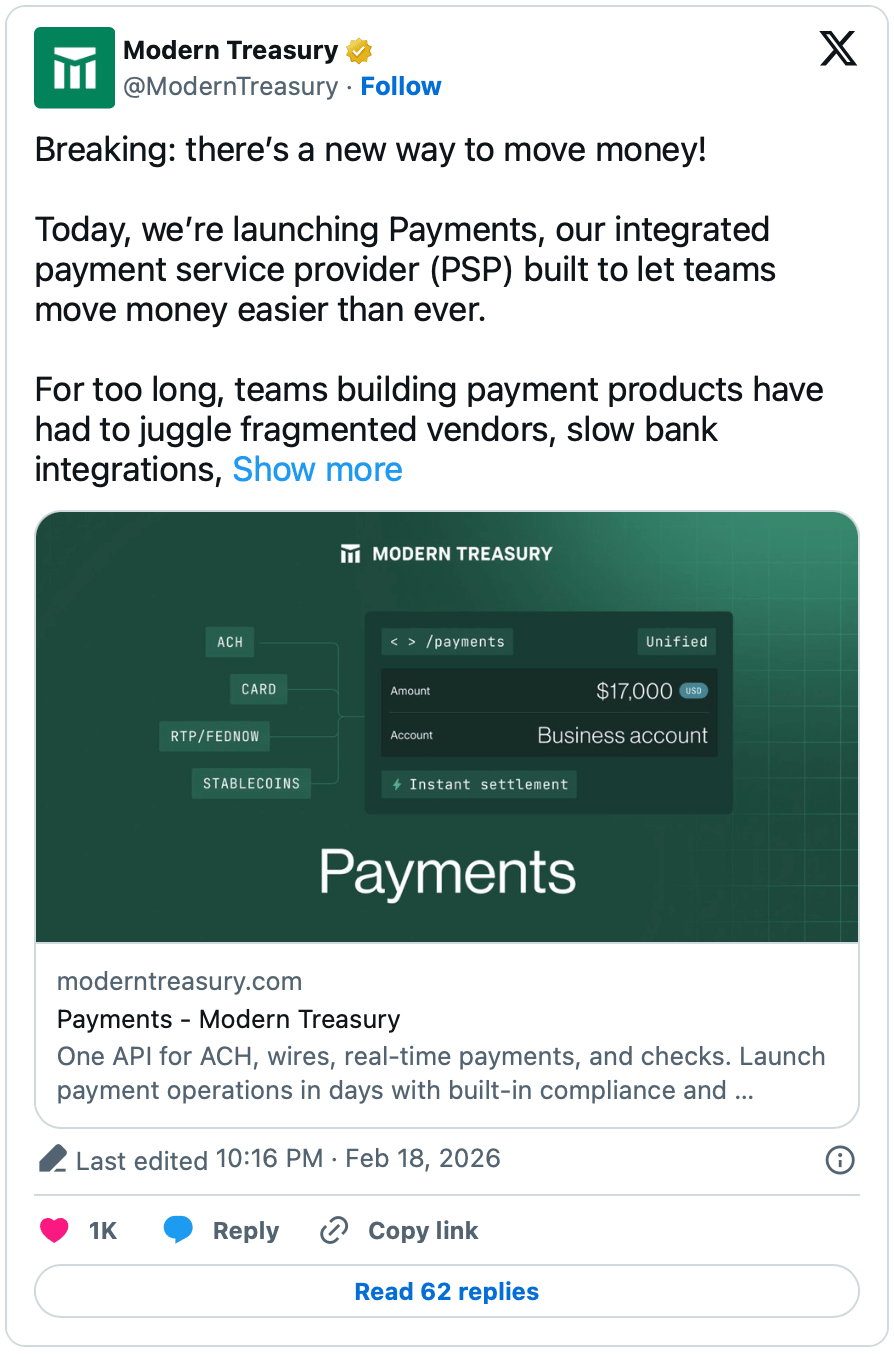
Crypto Rails: Modern Treasury has launched a payment service provider designed to compete with Stripe and Adyen, offering a unified API spanning ACH, wires, RTP, FedNow, cards, and stablecoins.
Bank Charter: Bridge, the $1.1bn stablecoin acquisition by Stripe, has received conditional approval from the Office of the Comptroller of the Currency to organise a national trust bank. The charter would permit custody, stablecoin issuance, reserve management, and cross-chain orchestration under direct federal supervision.
Valuable Data: The Federal Reserve has published research suggesting that Kalshi’s event contracts generate data of genuine utility to both researchers and policymakers. The appeal lies in Kalshi’s ability to compress scattered insights into market prices, producing forward-looking signals that sit alongside traditional surveys and macroeconomic data.
Energy Markets: Inframarkets is preparing to launch energy-focused prediction markets on Solana. The initiative seeks to translate expectations around power prices and infrastructure dynamics into tradeable contracts. In doing so, it extends the logic of event markets into one of the global economy’s most systemically important sectors.
Bitcoin Allocation: David Solomon, chief executive of Goldman Sachs, has disclosed that he owns Bitcoin, a notable shift for a banker who once described crypto as highly speculative. Under Solomon’s tenure in particular, Goldman has continued to expand trading and custody services for digital assets.
Vibe Coding: OpenClaw is now live on Noah, enabling users to deploy wallet-scoped, persistent agents on Solana in under a minute. As tooling becomes more seamless, the boundary between software experimentation and financial execution continues to blur.
Caught In 4K

Weekly Take

Keks & Giggles

And that's a wrap!
You can reach me anytime over on 𝕏 or drop me a line.
Talk soon!
DISCLAIMER
None of this is financial advice. This newsletter is strictly educational and is not investment advice or a solicitation to buy or sell any assets or to make any financial decisions. Please be careful and do your own research. Lastly, please be advised that we discuss products and services from our partners from which our team members may hold tokens/equity.